


As a devoted fan of Tolstoy, I have devoured all of his literary works. A few years ago, I stumbled upon a book titled “Tolstoy on Shakespeare: A Critical Essay on Shakespeare,” and was surprised to learn that my favorite author was not a fan of the famous playwright, who is widely regarded as one of the greatest writers in history. Personally, I struggle to connect with Shakespeare’s flowery language and find it off-putting. But I never expected someone in the literary world to blatantly criticize his work.
Here is an excerpt from the book:
“My disagreement with the established opinion about Shakespeare is not the result of an accidental frame of mind, nor of a light-minded attitude toward the matter, but is the outcome of many years’ repeated and insistent endeavors to harmonize my own views of Shakespeare with those established amongst all civilized men of the Christian world. I remember the astonishment I felt when I first read Shakespeare. I expected to receive a powerful esthetic pleasure, but having read, one after the other, works regarded as his best: “King Lear,” “Romeo and Juliet,” “Hamlet” and “Macbeth,” not only did I feel no delight, but I felt an irresistible repulsion and tedium, and doubted as to whether I was senseless in feeling works regarded as the summit of perfection by the whole of the civilized world to be trivial and positively bad, or whether the significance which this civilized world attributes to the works of Shakespeare was itself senseless.” — Tolstoy on Shakespeare: A critical Essay on Shakespeare by LEO TOLSTOY, Translated by V. Tchertkoff and I. F. M.
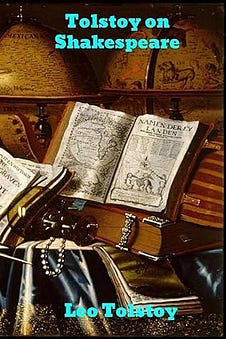
Tolstoy’s essay cast a critical eye on Shakespeare’s works, arguing that they lacked a moral compass and coherent narrative. He pointed to “Macbeth” as an example, highlighting the character’s descent into madness without a clear moral trajectory.
According to him, Shakespeare failed to provide a moral framework for audiences to interpret and evaluate the character’s actions, leaving them adrift in a sea of ambiguity. In essence, while Shakespeare’s plays might have been dazzling, they ultimately lacked depth and meaning without a guiding moral purpose.
Furthermore, he highlighted the playwright’s tendency to clutter his plays with unnecessary subplots and secondary characters. In “Macbeth,” Tolstoy saw the witches’ subplot as a mere spectacle that added little substance to the play. Similarly, in “Hamlet” and “King Lear,” he pointed to Fortinbras and Gloucester’s sons as examples of superfluous characters who detracted from the main themes.

Tolstoy also took issue with Shakespeare’s emphasis on dramatic spectacle over moral and philosophical depth, particularly evident in the supernatural elements of “Macbeth.” He argued that such distractions hindered the plays’ ability to engage with profound questions about human nature and morality.
He also criticized Shakespeare’s plays for being too convoluted, losing sight of their main themes in a maze of subplots and characters. For instance, in “King Lear,” the subplot involving Gloucester and his sons may have added unnecessary complexity and distracted from the play’s exploration of family dynamics, power struggles, and madness. According to Tolstoy, this focus on plot intricacies and spectacle took away from the moral and philosophical depth that should be at the heart of any drama.
In addition, he heavily criticized Shakespeare’s language and writing style, finding it to be overly ornate and artificial, lacking the raw emotion and authenticity that he believed was crucial in drama.
Specifically, in “Romeo and Juliet,” Tolstoy took issue with Shakespeare’s use of flowery metaphors and wordplay, particularly in Romeo’s soliloquy before meeting Juliet. He argued that this excessive poetic language made Romeo’s declarations of love seem contrived and insincere. According to Tolstoy, Shakespeare’s elaborate language obscured the true passion and sincerity of the characters, ultimately diminishing the impact of the play.
Furthermore, in “A Midsummer Night’s Dream,” Tolstoy called out Shakespeare for his constant use of puns and double entendres, especially in scenes involving the mischievous fairy, Puck. He believed that these linguistic tricks served no purpose other than to showcase Shakespeare’s cleverness, distracting from the coherence and clarity of the story.
He maintained that this reliance on linguistic acrobatics undermined the believability of the characters and their relationships, making it difficult for audiences to connect with the emotional core of the play.
Despite his critiques, Tolstoy begrudgingly accepted Shakespeare’s lasting impact on literature worldwide. The Bard’s mastery of human complexities and skill at crafting unforgettable characters and scenes could not be denied.
However, in Tolstoy’s eyes, Shakespeare’s works were lacking in the profound spiritual and moral insights that he held in high regard for great literature.
I haven’t read enough Shakespeare to truly delve into his works, but from what I have read, I was unable to connect with his writing, mostly because of his flowery language.
What I gathered from my reading was that engaging with Shakespeare requires a bit of patience and perhaps a different approach, like watching performances of his plays or reading modern translations and interpretations to bridge the gap between Elizabethan English and contemporary language. What do you think about that?
Also published on Medium.
 The Things I Know
I think both were excellent in their own aspects 👌well shared 👌
LikeLike
Absolutely. They both are amazing. And then liking any book is such a subjective choice. Thanks for stopping by:)
LikeLiked by 1 person