

When I first read Margaret Mitchell’s Gone with the Wind, I was completely blown away by this epic historical saga and coming-of-age story of survival and endurance.
Despite the length of the book (over 1000 pages), the pace never turns sluggish. I finished it in less than a week. Then, I eagerly waited for other members of my book club to finish reading it.
Everyone loved the book, but not for the reasons I had imagined. I was appalled to realize everyone else loved it because of Scarlett’s proto-feminist bad-ass characters.
Surely, Scarlett is a strong, passionate, and brave woman. She is self-willed and a survivor.
But she is also cold, calculative, and utterly manipulative. She is shallow and insensitive.
She cannot respond to genuine emotions of those who love her and pursues Ashley Wilkes throughout her three marriages for reasons that at most could be called inconsequential and vain.
She literally seems incapable of feeling genuine emotions. Her behavior is considerate only in case of matters non-vital.
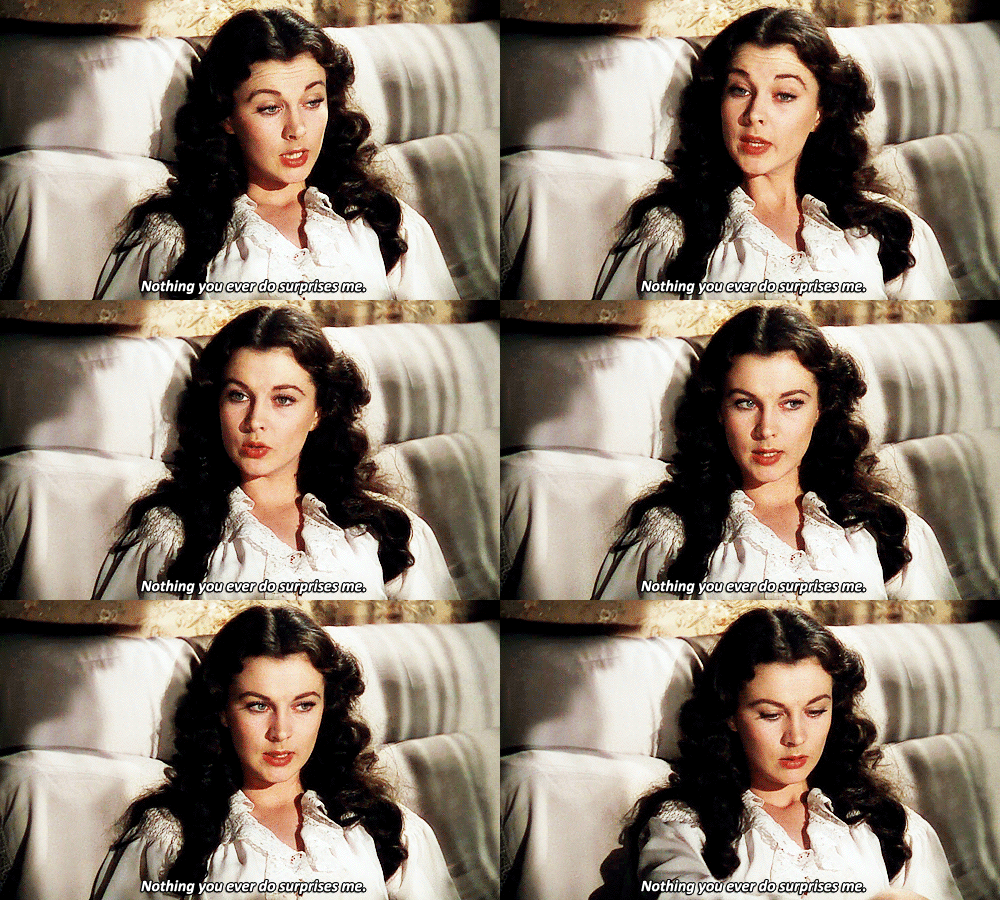
Scarlett O’Hara is a spoiled, selfish girl in the beginning. The adversities of the Civil War turn her into a hardened individual.
Melanie, on the other hand, never loses her humility despite going through the same set of adversities. It was shocking to realize that many people dismissed Melanie’s goodness, her self-sacrificing nature, and her gentleness as a weakness of character.
To me, Scarlett emerged as an antagonist. I disliked her throughout the narrative.
I was relieved to know that Mitchell didn’t change her throughout the book. I don’t think a person can really change, not the soul at least. Changes in attitude, behavior, habits, and interests do occur; that’s just personal growth over time. But a person’s soul, the inner core deep down, never changes.
I loved Mitchell for that. She took a negative character and made it her protagonist. Now if we look at the general definition of a psychopath, a psychopath is a person with a psychopathic personality, which manifests as amoral and antisocial behavior, lack of ability to love or establish meaningful personal relationships, extreme egocentricity, etc.
If not a complete psychopath, Scarlett definitely exhibited enough personality traits to be put in the category of partial psychopaths.
Many people would argue that she was considerate enough; however, her consideration was limited to trivial matters. The things that mattered most, she couldn’t care enough.
In an interview with a Sunday Journal that was broadcasted on radio in 1936, in answer to a question about Scarlett’s character, Margaret Mitchel clarified how hardship, poverty, and sorrow of the war changed Scarlett from a selfish, egocentric, but otherwise normal Southern girl to a hardened adventuress.
That officially should clear the matter for those who perceive and suggest that Mitchell wrote a flawless character in Scarlett.

Until a few years earlier, only the term ‘feminist’ was considered trendy. The era where a woman was celebrated for her accomplishments.
Nowadays, the term ‘bad-ass feminist’ has become a trend. The term ‘bad-ass’ originated in the 1950s: from the adjective bad + ass. Badass is defined as either—a tough, uncompromising, or intimidating person—or a formidably impressive person.
Nowhere, it’s defined as a selfish, egocentric, corrupt person.
Bad-ass feminism implies celebrating the women for their kick-ass attitude, but seemingly, it is purposely, insistently, and widely misrepresented and misunderstood.
Instead of idolizing a selfish and awful protagonist like Scarlett how about idolizing Charlotte Bronte’s Jane of Jane Eyre or L. M. Montgomery’s Anne from Anne of Green Gables or Louisa May Alcott’s Jo from Little Women and of course Mitchell’s Melanie? The list goes on and on.
It’s disheartening to think how people in general prefer a Scarlett over a Melanie. Well, that’s how it is.
***
Neena lives in Edmonton, Canada with her husband, two children, a highly energetic German Shepherd, and a lifetime collection of her favorite books.
A hermit at heart, she’s a permissive mother, a reluctant housekeeper, a superb cook, and a hard-core reader.
Tied to Deceit is her debut novel.
Want to know more about Tied to Deceit? Check here
Read a free excerpt from Tied to Deceit here
 The Things I Know
Mitchell intended Melanie to be the heroine of the novel. I read somewhere* that a psychologist wrote an article discussing Scarlett’s sociopathic personality not long after the book’s publication, and she was thrilled — as in, YES SHE IS A SOCIOPATH HOW DO PEOPLE NOT SEE THIS. She did feel that Scarlett had a few fine qualities — protecting her own, keeping her promises, always getting back up, but she was stunned when so many claimed to love Scarlett. Before she began Gone with the Wind she was reading a medical book about cold women. She was fascinated by psychology and put that interest into her depiction of Scarlett. Mitchell had strong principles as well as spirit: she would have identified with Melanie kindness more than Scarlett’s coldness, in my humble opinion.
*I believe my source is The Gone with the Wind Letters edited by Richard Harwell. I’ve read a lot on Mitchell so it’s hard to keep track. I am about 98% certain that’s the source though! 😉
LikeLiked by 2 people
That seems to be right. Scarlett’s basic egocentricity and her inability to understand others’ actions in accordance with principles they value makes her a very convincing character exhibiting some of the psychopathic traits.
As you said Jillian “Mitchell had strong principles as well as spirit: she would have identified with Melanie kindness more than Scarlett’s coldness, in my humble opinion.” I totally agree with that. Mitchell never changed Scarlett’s character. Despite continuous ups and downs, Scarlett stayed the same person throughout the book. Mitchell seemed to have acute understanding of human psychology. That tallies with the fact how she was fascinated by psychology and put that interest in depiction of Scarlett’s character.
LikeLike
“Instead of idolising a selfish and awful protagonist like Scarlett how about idolising Charlotte Bronte’s Jane of “Jane Eyre” or L. M. Montgomery’s Anne from “Anne of Green Gables” or Louisa May Alcott’s Jo from “Little Women”” – I agree… I didn’t like Scarlett when I read this novel, and didn’t like how it ended partly because I was waiting for her to be redeemed in some way (I assumed she could change, would change…!). Jo March is one of my favorite literary heroines 🙂
LikeLiked by 1 person
I’m glad there are many who thought exactly like me.
LikeLike